

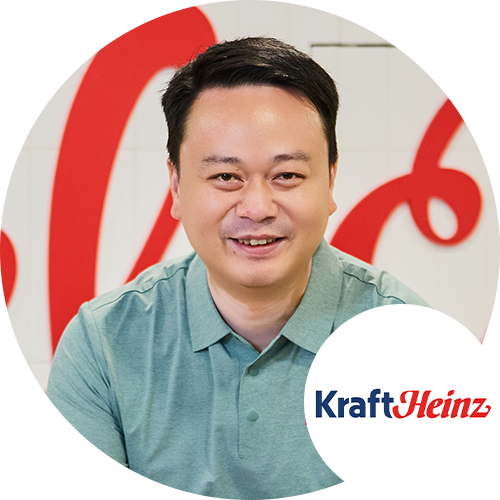
Peter Xiao was appointed as President of Kraft Heinz China in February 2025, overseeing the overall operations and management of Kraft Heinz China.
Mr. Xiao joined Kraft Heinz in February 2022 as Vice President of Procurement for the Asia region. In December 2023, he was appointed as Vice President of Operations, Procurement, and Sustainability for Kraft Heinz Asia, where he was responsible for driving supply chain excellence, procurement strategy, and sustainability initiatives. Under his leadership, the team successfully optimized supply chain processes, implemented green procurement practices, and enhanced sustainable supply chains, resulting in improved market competitiveness and social responsibility.
With over 20 years of experience in procurement and supply chain management, Mr. Xiao has a proven track record of driving operational efficiency and promoting sustainable development practices in multinational corporations. Prior to joining Kraft Heinz, he served as Procurement Director for the Asia Pacific region at Anheuser-Busch InBev, where he developed and executed regional procurement strategies, managed global logistics, and drove supply chain innovation. During his tenure, he delivered significant operational efficiencies through innovative procurement strategies and effective supply chain management, while advancing corporate sustainability practices.
Mr. Xiao holds an MBA from Fudan University and a bachelor’s degree in Scientific Japanese from Xi'an Jiaotong University.
As different retail channels come to play distinct roles in consumers’ minds—some representing value for money, others curated quality, and still others speed and instant fulfillment—the core question for brands has shifted accordingly. The challenge is no longer “where to sell,” but how a brand is understood and remembered within each channel.
Within this discussion, we will explore how brands can rebuild their product portfolios and channel strategies based on their positioning in consumer mindsets: which products should serve as vehicles for brand meaning, and which are designed to drive scale and efficiency; how supply-chain flexibility can support the differing rhythms and requirements of each channel; and how deeper forms of brand–retailer co-creation can establish clear and enduring divisions of cognitive roles.
In a highly diversified channel landscape, brands with true growth potential no longer attempt to cover every channel with a single, undifferentiated product. Instead, they learn to express a consistent brand identity through differentiated, intelligible product offerings, tailored to the specific logic of each channel.